



“Our strength comes from the ground”: Calum Gallacher is standing for SWU GS
Starting this week, eligible Social Workers Union members will see ballot papers land, asking them to vote for one of two candidates for the important role of General Secretary. Social Work Today interviews both candidates, giving members the chance to make an informed choice and enabling non-members to discuss issues affecting wider social work.
30/03/26
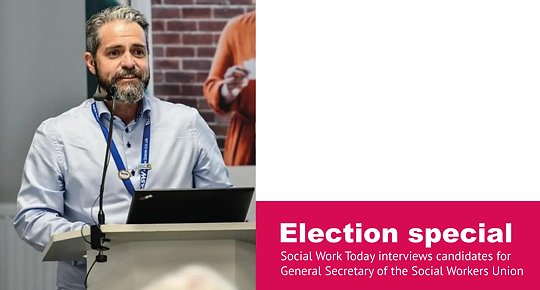
Ballot papers are being despatched this week for Social Workers Union (SWU) members to vote in the important election of the union’s leader.
SWU is a registered, independent trade union in the UK, specifically run by and for qualified social workers.
Voters can choose between Calum Gallacher, currently Assistant General Secretary (interviewed in this article); and Dave Callow, current SWU Chair. You can find Dave’s interview here: https://www.socialworktoday.co.uk/News/everyone-wants-to-feel-supported-dave-callow-is-standing-for-swu-general-secretary
The ballot return deadline is midday on April 29, with election results to be announced by SWU on April 30.
Q. So Calum, what is your current role within SWU? How long have you been part of the organisation?
“I joined SWU as a member in 2018 and I did my union contact training with Carol Reid, the National Organiser at the time, who was my introduction to SWU. I thought she was a fantastic energy and very committed and passionate.
“I was in a workplace where there was a high membership of SWU and BASW members. So I'd share information as a union contact and try and talk through difficulties with people and point them in the right direction. I've been a workplace rep before for two other big generalist trade unions.
“Then I’ve had the job as Assistant General Secretary since February 2023.”
Q. What would be your three priorities for SWU as General Secretary?
“I think the first priority is development of our presence in workplaces and making a meaningful difference for people on a more regular basis. So for me, that looks like developing a branch structure that empowers members, that enables them to actually have active governance over their trade union and to hold us as leaders accountable for the work that we carry out on their behalf.
“I want member voices to be at the forefront of every activity that we undertake, specifically campaigns, I think campaigns need to be locally developed. Because my working conditions where I am, maybe somewhat different to the working conditions of somebody else in a different authority – or because they might happen to be a black or an Asian woman or man. We experience different difficulties in our workplaces.
“For me, I've had the pleasure in this role as [Assistant General Secretary] to have been able to work closely with the diaspora social work group. I was at one of their meetings last week and I continue, I continue to direct people towards their community because they've achieved this amazing forum with very little support or assistance from organisations, because they're highly motivated, skilled social workers, but also experienced in terms of the oppression, the systemic oppression that they faced. […] They've voluntarily created this supportive community for other diaspora social workers. And I think that's something that we need to support elevating, because it's a chronic issue: racism in social workplaces.
“I also think the adult social care WRES (Workplace Race Equality Standards), needs to be mandated in workplaces, particularly in local authorities. So that is something that I would like to commit to. I think if any trade union was to back the adult social care WRES, I think it should be the Social Workers Union.
“I would like my priority as modernizing how we do things here. I don't know if you can say that because that might bring some challenge, but we need to embrace the fact that our strength comes from the ground. Our strength comes from our presence in workplaces, the members that we have, and being able to make an effective difference for those members.”
Q. I saw your pledge to cut the salary of General Secretary should you win*. Tell me about this.
“In social work, we have the responsibility of making decisions and ensuring that there's efficacy of public spending. So it's not really any different when it comes to being responsible for members' money.”
“I think any salary increments should be voted on annually at an AGM, and any salary increases that have been proposed by any sort of structure within the union should be proposed to membership at an AGM and there should be opportunity to discuss that. But also, it's reasonable that the General Secretary of the Social Workers Union would only take a pay award in line with the 3% that the majority of other social workers are taking.”
Q. What is your social work background and what skills and experience do you bring to the table with this?
“I was a serial non-attender at school. And I pretty much left school with no education other than a standard grade, a credit standard grade for English, because I just never applied myself. I realise now, years later, after a period of burnout from social work, that I've got ADHD. And it's like, oh, yeah, that makes sense.”
“I had an allocated social worker. And that was fine. It was positive in the sense that it enabled me to leave school and get into a different education situation, and feel like I was more fairly treated. Somebody asked me recently, if that had influenced me becoming a social worker. I don't think it ever consciously did. But it was more like I've always had this unblinking ability, passion, desire to fight for justice. It's like I really struggle when things are not equal, when they're not fair, when people are treated unfairly.”
Q. The hustings** that's being filmed today, you’ve decided not to take part. What's your reasoning for that?
“I just think that if I was to agree to do the hustings, I would be reinforcing poor practice and I would be reinforcing or dismissing the significance of members' voices, how important they are throughout everything that we do, but particularly at a time of what might be significant change. And listening to those voices genuinely with intent is really important.
“I can't see why we're not having hustings openly on an open platform where every member can access it, not just a select few. And also for me, the greatest issue that I have with the platform chosen is the permissions that are set to prevent any sort of democratic participation. There is no chat function for members to be able to read the questions or the thoughts or the views that are coming up for them as people talk. That those questions are only fielded behind the scenes by people who are facilitating the hustings – which it's not, it's a webinar, it's a pre-planned recorded webinar – that will be edited before it's shared with members. That's not a live hustings.”
Q. Tell me about the SWU Skills Test***. I wanted to get your thoughts on this and its importance and relevance to the election.
“I think it's, for me, it seems like an arbitrary process. There was, again, there was very little information provided about it. I'm not sure that there was any sort of equality impact assessment for it.
“I can appreciate that it's important to know legislation. As a social worker, I've got a really broad, evolved understanding of legislation and how that applies in practice. But if you'd put me through a one-hour exam right now, about the Social Work Scotland Act and the Adults with Incapacity Act and the Mental Capacity Act and the Care Act and, the Mental Health Care and Treatment Act and the Mental Health Act with amendments in 2007 in England and Wales. It's like, would I pass an invigilated exam on that right now? No, because as a social worker – what I'm familiar with, and I think what most are familiar with – is being able to actually go and find the legislation and then apply it to make the argument that you need to make to uphold the decision that needs to be made to make sure that you are in accordance with your statutory responsibilities.
“I would say that being able to recite sections of TULRCA [Trade Union and Labour Relations (Consolidation) Act 1992] off my heart. I don't think that's going to be as beneficial on a daily basis as General Secretary of the Social Workers Union as having insight and experience and still being current in practice, knowing what people are going through.
“So as a social worker, I've got first-hand experience and really I don't think being able to cite sections of TULRCA serves any purpose. And I think that the exam is an arbitrary barrier that's been put in place to be selective about who might be successful. And I question the integrity of a ballot that wants to publish on the ballot slip, endorsed and not endorsed.”
Q. At the most recent AGM, a motion was put forward to explore the possibility of separation from BASW. I just wondered what your thoughts on it are now?
“I do think there's a need to look at the cooperation agreement and make that more meaningful and relatable in our daily work together […] I think there's room for us to develop our relationship with BASW.
“We both have a shared responsibility for the people who pay their subscriptions to us and what they need in terms of professional support from the professional body. And that is who should be providing the professional support.
“The trade union, on the other hand, needs to be about how we build momentum on collective issues and are able to take that forward to affect change for people on a micro-level in their workplaces with a ripple effect further out. And actually, yeah, challenge injustices in employment and social injustice more nationally. I think there needs to be a clearer distinction between what BASW do and what we're here to do.”
“I'd like to see both organisations continue to work together because I think together we can offer our membership more. However, I do think there needs to be an option of more autonomy in certain things. And certainly that is something that comes up at member events.”
Q. What would failure look like after one year in-post?
“For me, failure would be not have been able to rebuild a stronger relationship with BASW, not being able to demonstrate that a change in focus is leading to an increase in membership, but more importantly, greater member satisfaction. It's feedback from members. If I hear members saying that they don't feel that they're being engaged or they're not being consulted about serious decisions, then I would take that as a personal failure because that's something that we should be embracing.”
Q. Tell me a decision you’d make as General Secretary that would make you unpopular.
“I know my pushing of openness and transparency, especially about activities and funds, is making me unpopular at the moment – but, I'd say that's a minority. I think any changes and serious decisions to be made need to be done with membership. I don't think I'm going to radically just go out and change things all of my own accord.”
Interviews took place on Tuesday 24 March
* Calum has made a pledge in his campaign to cut the General Secretary salary by 25%. A social media post quotes the salary as £86k, though both candidates would start at a lower level of £73k per annum. Calum confirmed he intends to reduce both the starting and final salary by 25%.
** As part of the election, SWU hosted a formal hustings, the only official election event taking place. A statement, published after this interview was conducted, said the hustings was in the form of a live recording and an uncut video would be published. SWU said questions that had been pre-submitted by members would be presented by host, BASW Communications & External Relations Officer, Jonny Adamson.
*** The SWU Nominations Committee introduced a Skills Test to support the union in assessing candidates’ knowledge and experience relevant to the role of General Secretary. While passing the exam was not required in order to stand for election, ballot papers will display ‘endorsed’ or ‘not endorsed’ by SWU. SWU says candidates who chose not to take part in the skills test were informed that they would not receive SWU endorsement on the ballot paper if it was not completed.


Social Worker / Senior Social Worker
Job of the week
Sign up for an informal interview for this role today
£43,149 - £49,817

Featured event


Featured jobs

Children’s Homes Deputy Manager

Senior Lecturer / Lead Social Worker

Most popular articles today

Half of primary school teachers report a rise in safeguarding referrals linked to neglect

More than 1,000 autistic people left in mental health hospitals for over two years

Adult social work vacancies persist despite improvements in recruitment and retention

Kinship carers call for statutory paid leave as lack of support harms children
Sponsored Content